|
The Shimmering Path
by Gillie Whitewolf
On
a beautiful Beltane dawn I sat in my garden watching
the sky brighten, serenaded by birds... and the
gentle squelching of snails as they breakfasted
on fading daffodil foliage. I rarely cut back the
foliage after the daffodils have shared their Spring
beauty. I choose to leave it to die back naturally
not only to allow the plant to return nutrients
back to the bulbs [promising a healthy show the
following year] but to provide the ground with protection
from the sun's heat, and also give shelter and food
for a variety of wildlife.
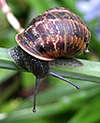
This particular Beltane morning I studied the patterns
of my garden gastropods and their dining routines
- first the snails, then the slugs. I sat engrossed
by the journeys of these surprisingly athletic garden
companions and pondered on how misunderstood and
under-valued they are. These fascinating creatures
are essential to our gardens, one might even consider
them our very own green refuse collectors as many
favour decomposing plants and decaying leaves, and
some have even been known to munch on decomposing
cardboard and paper. They also provide food for
other wildlife - birds such as the Thrush and the
Corvidae family will deftly crack open a snail shell
to reveal a quick meal, and hedgehogs, shrews and
other small mammals, ground beetles and even toads
will gladly feast on slugs.
 Sadly
it seems that the average gardener would rather
reach for a poison to rid their gardens of snails
and slugs - not only causing serious danger to other
wildlife which feeds on them, but also ridding their
gardens of these helpful refuse diners. "But
they eat my prize plants" I hear you cry -
so give them something else to eat and choose appropriate
friendly methods to protect the plants you don't
want munched. Broken eggshells, horserhair rope
or gritty gravel can be placed around delicate plants,
although if your soil is very alkaline it is best
to avoid using eggshells as they will only increase
the calcium levels in the soil. Copper provides
a very effective barrier to slugs and snails - and research* is proving that copper
is also very beneficial to your soil, energising
and harmonising the soil and producing healthier
plants with increased yields. If you can afford
copper gardening implements get out there and buy
them! Otherwise, try placing copper tape or objects
around plants which seem to bear the brunt of the
snail and slug attack. Sadly
it seems that the average gardener would rather
reach for a poison to rid their gardens of snails
and slugs - not only causing serious danger to other
wildlife which feeds on them, but also ridding their
gardens of these helpful refuse diners. "But
they eat my prize plants" I hear you cry -
so give them something else to eat and choose appropriate
friendly methods to protect the plants you don't
want munched. Broken eggshells, horserhair rope
or gritty gravel can be placed around delicate plants,
although if your soil is very alkaline it is best
to avoid using eggshells as they will only increase
the calcium levels in the soil. Copper provides
a very effective barrier to slugs and snails - and research* is proving that copper
is also very beneficial to your soil, energising
and harmonising the soil and producing healthier
plants with increased yields. If you can afford
copper gardening implements get out there and buy
them! Otherwise, try placing copper tape or objects
around plants which seem to bear the brunt of the
snail and slug attack.
The Great Grey Slug [Limux maximus] does in fact
do no damage to your garden crops because it lives
on a diet of decaying leaves and fungi. Likewise
the Great Black Slug [Arian ater] dines on rotting
vegetables. Most snails, including the Garden Snail
[Helix aspersa] and Roman Snail [Helix pomatia]
will also merrily chomp away on decomposing plant
matter. There are a few gastropods which can be
more harm than good - the Netted Slug [Deroceras
reticlatum], which is cream to brown or grey in
colour often speckled black and exudes a milky slime
when handled, does enjoy feasting on vegetable crops,
and the Budapest Slug [Milax budapestensis], which
is found mainly on cultivated land, is known to
attack crop roots. But before you reach for the
slug pellets why not encourage their predators to
your garden, or try enticing them away with alternative
foods - open a gastropod diner! The slugs and snails
in my garden absolutely love pumpkins and melons.
Having a compost area not only helps reduce your
household waste and create a rich feed for your
plants, but also provides shelter and food for countless
species of wildlife. Any raw fruit or vegetable
matter can be thrown on the compost, along with
tea-bags, coffee grounds, old flowers, grass cuttings,
sawdust, hedge trimmings and young weeds. Bananas
make excellent additions to compost heaps as they
actually speed up the decomposition process [which
is why bananas should never be stored alongside
other fruit!]
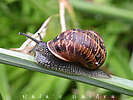 Snails
alternate between periods of activity and prolonged
periods of rest, sleeping during spells of dry weather
and hibernating during cold winters. When they withdraw
to hibernate they enter a state of deep sleep, preparing
themselves by secreting a number of slime layers
over the shell's entrance in an effort to keep out
the cold and some predators. They are often found
nestling under upturned flower pots and cracks in
walls. Like snails, their cousins the slugs also
require a damp habitat and run the risk of desiccating
in dry conditions. This explains why the rain and
dew usually brings with it the stream of gastropod
visitors. They move by waves of muscular contractions
along their one and only foot [basically their underside],
which also contains a special gland which secretes
a sticky slime. As the movement puts pressure on
the sticky slime it turns into a liquid, allowing
the snail/slug to slide forward - and rather ingeniously
this liquid then turns back to a sticky slime to
prevent the creature from sliding backwards! A coating
of slime not only helps prevent desiccation but
also offers some protection from enemies, and the
sticky factor enables them to move over a number
of surfaces freely, leaving a shimmering trail behind
- as well as providing them with a tracking scent,
which in some species also doubles as a predator
deterrent. Snails
alternate between periods of activity and prolonged
periods of rest, sleeping during spells of dry weather
and hibernating during cold winters. When they withdraw
to hibernate they enter a state of deep sleep, preparing
themselves by secreting a number of slime layers
over the shell's entrance in an effort to keep out
the cold and some predators. They are often found
nestling under upturned flower pots and cracks in
walls. Like snails, their cousins the slugs also
require a damp habitat and run the risk of desiccating
in dry conditions. This explains why the rain and
dew usually brings with it the stream of gastropod
visitors. They move by waves of muscular contractions
along their one and only foot [basically their underside],
which also contains a special gland which secretes
a sticky slime. As the movement puts pressure on
the sticky slime it turns into a liquid, allowing
the snail/slug to slide forward - and rather ingeniously
this liquid then turns back to a sticky slime to
prevent the creature from sliding backwards! A coating
of slime not only helps prevent desiccation but
also offers some protection from enemies, and the
sticky factor enables them to move over a number
of surfaces freely, leaving a shimmering trail behind
- as well as providing them with a tracking scent,
which in some species also doubles as a predator
deterrent.
If, like me, you rather enjoy the company of these
useful friends ensure that your garden has plenty
of slug and snail friendly habitats - leave wild
areas with long grass to provide shelter from the
heat, or allow low spreading weeds and ivy a place
in your garden. Allow some foliage to die back naturally,
providing shelter and food. Rock piles, paving slabs
and upturned flower pots all provide a suitable
resting place and moist habitat. A log pile offers
a home to a whole host of wildlife besides the gastropods,
including many beneficial creatures such as the
hoverfly of which some species lay their eggs in
rotting logs or dead tree trunks [the hoverfly larvae,
similar in appearance to small slugs, are a very
useful addition to your garden as they have a ferocious
appetite for aphids].
So
next time you see a shimmering path don't frown
- consider it a greeting from one of our most misunderstood
and mistreated garden companions and natural refuse
collectors... and a Gastropodical Blessing!
|
|