

|
A valuable plant for a wide range of wildlife, the stinging nettle harbours an incredible number of insects and invertebrates - some of which, like the nettle weevil, exist solely on nettles. Red admiral, small tortoiseshell, painted lady, comma and peacock butterflies are all attracted to stinging nettles, where they will lay their eggs, the resulting caterpillars having an immediate source of nutritious food. Nettle patches also tend to support over-wintering aphids, which provide an early food source for ladybirds and their larvae and lacewing larvae. The honeydew produced by aphids will also provide food for ants - and in return the ants will protect the aphids from other predators. Not surprisingly the nettle patch is a magnet for birds and other insect-eaters, whilst seed eating birds will be attracted in the late summer when the nettle produces a huge quantity of seeds. . Nettles are also useful for plant life as well and a rich plant feed can be made from steeping nettles in water to make a 'nettle tea' which can be used neat to spray on foliage to deter pests and prevent fungal diseases, or used diluted to water the plants or soil. Alternatively nettles can be added to the compost heap where its nitrogen will assist in the breaking down of other plant matter. It has been reported that herbs with stinging nettles as neighbours tend to be healthier than those without and have a higher concentration of essential oils, making them more resiliant to pests. Nettles tend to rob the soil of nutrients, resulting in a plant rich in minerals and vitamins, including iron, sulphur and silicon, beta-carotene, vitamins C, D and A and chlorophyll - for a healthy addition to your meals try steaming or cooking the fresh young nettle-tops, in much the same way as Spinach, and serve as a vegetable garnished with butter, use as an ingredient for a healthy soup, or add to a vegetarian lasagne or pasta bake. The French are so passionate about the stinging nettle that they make it not only into the classic soup, but also omelettes, sauces, jam and icecream (!), syrups, ales and liqueurs. If you are harvesting your own nettles for consumption be sure to pick only young, fresh tops, ideally in the Spring, although you should be able to harvest fresh tops throughout the Summer - wear some thick gardening gloves to avoid being stung, or snip the tops off so that they fall into a basket. Ensure that you only pick nettles which are free from crop spray and avoid ones found growing by the side of busy roads or in built up areas. If you are harvesting the root the best time is in the Autumn. The
practice of urtication (generally as a remedy to
rheumatic and arthritic aches and pains) dates back
at least 2,000 years - fresh nettles are used to
sting the affected area. This practice still continues
today, and those that use it do report considerable
relief from arthritic pains, but if you'd prefer
a gentler option try drinking a nettle infusion
on a regular basis - which will help clear out toxins
in your joints. Nettle has a long history of use
for arthritis, rheumatism and gout, and is effective
at treating other inflammatory conditions such as
tendonitis and bursitis. Nettle tea is also an effective remedy for dust and pollen related allergies / hay fever and asthma - in fact the stinging nettle is highly beneficial to the respiratory system in general, and has a long history of use in treatments for bronchitis, whooping cough, colds, tuberculosis and related lung problems. Culpeper recommended the use of nettles to ’...consume the phlegmatic superfluities in the body of man, that the coldness and moisture of winter has left behind.’ I mentioned earlier that nettle is beneficial to the kidneys - so it should come as no surprise that it's a remedy for [and preventative of] kidney stones. It's also a remedy for bladder infections - and it's a gentle and safe herb so you can happily drink several cups of nettle tea a day. It will help flush out toxins and support your kidneys, liver and circulatory and respiratory systems (which will in turn help remedy respiratory problems, clean out toxin build ups in joints and inflamed joints and tendons etc..) For skin conditions dried nettles make an excellent healing ingredient to facial steams, and a nettle infusion or cream is good for acne, boils, and oily skin. Nettles are great for the hair (and have been cited as a remedy to thinning hair and baldness). If you're cooking any nettles up to eat, reserve the water you use to cook them in and use it as a hair rinse. Or you could just brew up a strong infusion of dried nettle leaves [and / or roots] and use as a hair rinse / scalp friction, or make up a herbal cider vinegar by steeping nettles in cider vinegar for a few weeks. Of course, drinking (or eating) nettles will also help improve hair condition. Plant
fibres from the stem of the nettles have a long
history of use in the making of everything from
ropes and papers, clothing and tablecloths, to sails
and fishing nets and makes a surprisingly strong
and smooth-textured fabric - reputedly stronger
than cotton and finer than Hemp. A Bronze Age burial
in Denmark revealed a shroud created from such fabric.
During World Wars I and II the tough plant fibres
were made into textiles and during WWII nettles
were collected in quantity to prepare a dye for
military uniforms. This role as a plant dye was
not a new one, it has a long history of use as a
popular wool and yarn dye - the leaves a yield a
green dye, whereas the roots boiled with salt or
alum yield a beautiful yellow dye. Modern research
into Nettle as a crop suggests that although it
gives a lower fibre yield than flax, it represents
a much more environmentally friendly fibre crop
compared to cotton - not only does it require less
agrochemicals and irrigation, but as previously
stated also supports numerous species of wildlife.
Long live the Stinging Nettle! A
passage from Les Miserables concerning the
lovely Stinging Nettle :
4
large handfuls of nettle tops 1.
Strip the nettles from the thicker stalks, and wash. The
poet, Campbell, complaining of the little attention
paid to the Nettle in England, tells us: |
|








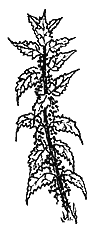 The
common Stinging Nettle (Urtica dioica) is one of
the first edible wild plants to emerge in the spring
and can be found growing in rich soils in forest
clearings, stream banks, old fields or wastelands
and disturbed soil. The stem is ridged, bristly
and hairy, the leaves grow opposite one another
and are oval or heart shaped at the base, narrowing
to a long point, with toothed edges. Tassel-like
clusters of greenish flowers appear in the Summer,
with male and female flowers on separate plants.
The stem and leaves are notoriously covered in stiff
stinging hairs, the tip of which breaks off when
touched, leaving a hollow hair which injects the
skin with a fluid containing irritant poison. The
juice from the stem of the stinging nettle actually
makes a remedy to the plants' sting - next time
you're stung try breaking the stem and applying
the juice to relieve the stinging sensation. Failing
that you'll usually find the faithful Dock Leaf
growing nearby, the leaves contain chemicals which
will neutralise the sting and cool the skin.
The
common Stinging Nettle (Urtica dioica) is one of
the first edible wild plants to emerge in the spring
and can be found growing in rich soils in forest
clearings, stream banks, old fields or wastelands
and disturbed soil. The stem is ridged, bristly
and hairy, the leaves grow opposite one another
and are oval or heart shaped at the base, narrowing
to a long point, with toothed edges. Tassel-like
clusters of greenish flowers appear in the Summer,
with male and female flowers on separate plants.
The stem and leaves are notoriously covered in stiff
stinging hairs, the tip of which breaks off when
touched, leaving a hollow hair which injects the
skin with a fluid containing irritant poison. The
juice from the stem of the stinging nettle actually
makes a remedy to the plants' sting - next time
you're stung try breaking the stem and applying
the juice to relieve the stinging sensation. Failing
that you'll usually find the faithful Dock Leaf
growing nearby, the leaves contain chemicals which
will neutralise the sting and cool the skin. 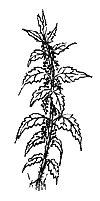 Nettle
Soup
Nettle
Soup
Gaia's Garden Library
Non Fiction Section : Gaia's Garden Herblore | Susun S. Weed Articles | Articles and Musings
Fiction Section : Short Stories & Prose| As Told
By Cat | Public Domain Texts| Poetry
Shop | Library | Gallery | Forum | Contact | Links